DM Plant (Demineralized Water Plant)
DM Plant (Demineralized Water Plant) for Industrial and Laboratory Use
A DM plant (demineralized water plant, also called a DM water plant or demineralization plant) is a water treatment system that removes dissolved mineral salts from water by ion exchange. Water passes through cation and anion resin beds that swap dissolved ions for hydrogen and hydroxyl ions, producing high-purity, low-conductivity water for boilers, pharmaceuticals, laboratories, power plants and industrial processes.
PI Pure RO System designs, supplies and installs DM plants from Indore for industries across Madhya Pradesh and India. Our DM plants are sized to your raw water analysis and purity target, and come with installation, commissioning and after-sales support. Below you will find how our DM plant works, the ion exchange principle behind it, its process stages and where DM water is used.
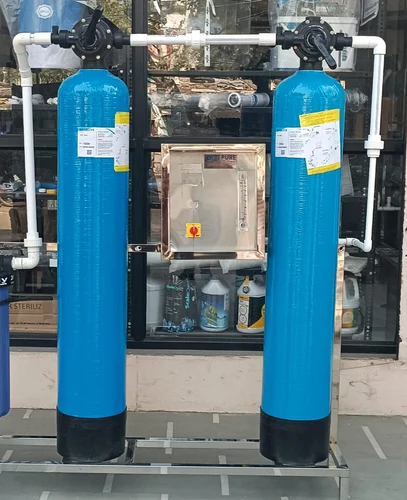
Our DM Plant at a Glance
Feature | What you get |
|---|---|
Technology | Ion exchange with cation and anion resin beds, plus optional degasser and mixed bed polisher |
Configurations | Two-bed, degasser type, mixed bed, RO + DM and compact laboratory units |
Capacity | Customised, from laboratory units to industrial plants in the cubic metres per hour range |
Treated water | Conductivity as per your requirement: about 10 to 30 µS/cm (two-bed) and about 1 to 5 µS/cm (with mixed bed) |
Operation | Manual, semi-automatic or PLC-based regeneration |
Vessels | FRP, MS rubber-lined or stainless steel, as per application |
Scope | Pre-treatment filters, resin beds, regeneration tanks, piping, instruments and control panel, as per quotation |
Support | Installation, commissioning, operator training and AMC |
What Is a DM Plant (DM Water Plant)
Natural water carries dissolved salts such as calcium, magnesium, sodium, chloride, sulphate, bicarbonate and silica. In boilers, heat exchangers and process equipment, these salts form scale and cause corrosion or product contamination. A DM plant removes almost all of these dissolved ions, so the treated water has very low total dissolved solids (TDS) and conductivity.
A DM plant removes ionic impurities only. Bacteria, organic matter and suspended solids are handled by pre-treatment such as sand and carbon filters, or by an RO stage ahead of the DM unit.
Working Principle of a DM Plant: Ion Exchange
A DM plant works on the principle of ion exchange. Ion exchange resins are tiny polymer beads with charged sites. The cation resin holds hydrogen ions (H+) and the anion resin holds hydroxyl ions (OH-). As water flows through, the resin swaps the dissolved ions in the water for its own:
- Cation exchange: calcium, magnesium and sodium ions (Ca²⁺, Mg²⁺, Na⁺) are captured by the cation resin and replaced by H+. The water turns mildly acidic, containing mineral acids and carbonic acid.
- Degassing: carbonic acid breaks down into carbon dioxide (CO₂), which a degasser removes. This reduces the load on the anion resin.
- Anion exchange: chloride, sulphate, bicarbonate and silica are captured by the anion resin and replaced by OH-.
- Neutralisation: the H+ and OH- released combine to form pure water (H+ + OH- → H₂O).
- Polishing (optional): a mixed bed unit, with cation and anion resin in one vessel, removes the last traces of ions.
Our DM Plant: Process Flow
Stage | Purpose |
|---|---|
Raw water tank and feed pump | Stores feed water and delivers it at the required flow |
Pressure sand filter | Removes suspended solids and turbidity |
Activated carbon filter | Removes chlorine, organics and colour that damage resin |
Strong acid cation (SAC) exchanger | Replaces calcium, magnesium and sodium with hydrogen ions |
Degasser (decarbonator) | Removes carbon dioxide formed from bicarbonates |
Strong base anion (SBA) exchanger | Removes chloride, sulphate and silica |
Mixed bed polisher (where required) | Final polishing to very low conductivity |
DM water storage tank | Stores treated water for use |
When a resin bed is exhausted, it is regenerated: cation resin with acid (hydrochloric or sulphuric acid) and anion resin with caustic soda (sodium hydroxide). Many plants use PLC or semi-automatic controls to run the service, backwash and regeneration cycles.
DM Water Quality: DM vs DI Water
Type | Best for | Note |
|---|---|---|
Two-bed DM plant (cation + anion) | Boiler feed and general industrial use with low to moderate TDS feed | Economical for good-quality feed water |
DM plant with degasser | Feed with high bicarbonate alkalinity | Reduces anion resin load and chemical use |
Mixed bed DM plant | Pharma, laboratory and electronics needs | Gives the lowest conductivity |
RO + DM plant | High TDS borewell water | RO removes most salts first, so resin regenerates less often and chemical use drops |
Compact lab DM unit | Laboratories and small processes | Low flow, small footprint |
For high-TDS feed, the combination of an RO plant and DM is often the most economical design over the plant’s life.
Applications of a DM Plant
Application | How DM water is used | Why it matters |
|---|---|---|
Boilers and steam generation | Boiler feed and make-up water | Prevents scale, silica carryover and corrosion |
Power and cogeneration | Boiler make-up and cooling systems | Protects tubes and turbines |
Pharmaceutical units | Feed to further purification, equipment rinsing | Low ionic load for downstream treatment |
Laboratories | Reagent preparation and glassware rinsing | Avoids ionic interference in tests |
Electronics and battery production | Rinsing, process water and battery top-up | Ionic contamination affects product quality |
Textile and dyeing | Dye baths and rinsing | Consistent colour, fewer deposits |
Food and beverage processing | Process steam, cleaning and rinsing | Consistent product quality |
Chemical and engineering industries | Process make-up and coolant preparation | Prevents deposits in equipment |
DM Plant vs RO Plant
RO plant | DM plant | |
|---|---|---|
Principle | Membrane separation under pressure | Ion exchange with resin |
Removes | Most dissolved salts, bacteria, organics | Dissolved ionic salts, including silica |
Chemicals | Antiscalant and periodic cleaning | Acid and caustic for regeneration |
Reject | Continuous reject stream | Regeneration effluent |
Best for | Medium to high TDS water | Low TDS feed or final polishing |
Purity | Good | Very high, especially with mixed bed |
Types of DM Plants We Supply
Treatment | Typical conductivity | Typical use |
|---|---|---|
Two-bed DM plant (cation + anion) | about 10 to 30 µS/cm | Boiler feed, general process use |
DM plant with mixed bed polisher | about 1 to 5 µS/cm | Pharma, laboratory and electronics use (often called DI water) |
The actual figure depends on raw water quality, resin condition and plant design. DM water is the output of the cation and anion beds, while DI (deionised) water is DM water polished further, usually through a mixed bed.
How We Size Your DM Plant
Capacity is customised, from small laboratory units to industrial plants in the cubic metres per hour range. To size a plant correctly we need:
Daily DM water demand and operating hours
Raw water analysis: TDS, hardness, alkalinity, chloride, sulphate, silica, iron and pH
Required outlet quality: conductivity and silica limit
Regeneration preference: manual, semi-automatic or PLC-based
Space, power and effluent handling at the site
The price of a DM plant depends on capacity, number of beds, mixed bed requirement, vessel material, automation level and feed water quality. Share your requirement and water report to receive a detailed quotation.
Maintenance and Resin Regeneration
Record inlet and outlet conductivity every shift
Regenerate after a set throughput or when outlet conductivity rises
Use the correct acid and caustic strength and quantity
Backwash filters and beds as per the SOP
Protect resin from chlorine, iron and oil with proper pre-treatment
Test and replace resin when capacity falls noticeably
We also supply RO water chemicals, water softeners and spares to keep the whole system running.
Service Area: Indore, Madhya Pradesh and Across India
PI Pure RO System is a DM plant manufacturer in Indore, supplying and installing plants in Pithampur, Dewas, Ujjain, Ratlam, Dhar and across Madhya Pradesh, with pan-India dispatch and technical support.
PI Pure RO System 27-B, Pandit Dwaraka Prasad Mishra Marg, near Annapurna Road, Sudama Nagar, Indore, Madhya Pradesh 452009 Phone: +91-7000141373 | Email: salespipure@gmail.com
Get a Free Water Treatment Consultation
Need the Right Water Treatment Solution? Trusted Water Treatment Experts Since 2014
- Customized Water Treatment Solutions
- Industrial & Commercial RO Plants
- Water Treatment, ETP, STP & DM Plants
- Expert Design, Installation & Commissioning
- Energy Efficient & Cost-Effective Systems
- Pan India Sales & Technical Support
Frequently Asked Questions :-
A DM plant (demineralised water plant) removes dissolved mineral salts from water using cation and anion ion exchange resins, producing low-conductivity, high-purity water for boilers, pharma, laboratory and process use.
Water passes through filters, then a cation exchanger, a degasser, an anion exchanger and, if needed, a mixed bed polisher. The resins swap dissolved ions for hydrogen and hydroxyl ions, which combine to form pure water.
A DM plant works on ion exchange. Cation resin replaces positive ions such as calcium, magnesium and sodium with hydrogen ions, and anion resin replaces negative ions such as chloride, sulphate and silica with hydroxyl ions.
DM water is used for boiler feed, power generation, pharmaceutical and laboratory processes, electronics and battery production, textile processing and other industrial uses that need low mineral content.
An RO plant separates salts using a membrane under pressure, while a DM plant removes ions with resin that is regenerated with acid and caustic. For high-TDS water, an RO plant followed by a DM or mixed bed unit is often the most economical choice.
A two-bed DM plant typically gives conductivity of about 10 to 30 µS/cm, and a mixed bed polisher can bring it to about 1 to 5 µS/cm. The exact figure depends on the raw water and plant design.
It depends on the raw water TDS, resin volume and daily consumption. Plants are regenerated after a set throughput or when outlet conductivity rises. Adding RO before the DM stage greatly extends the time between regenerations.
Yes. PI Pure RO System supplies and installs DM plants in Indore, Pithampur, Dewas and across India, with design, installation, commissioning and after-sales support.