In water purification on a large scale, efficiency is the key to reducing operational costs and ensuring consistency in water quality. Improved reverse osmosis and modern industrial reverse osmosis systems and commercial reverse osmosis plants employ improved technologies to do this. The RO control panel and the electronic dosing pump are two important devices that contribute to improved performance. Their combination results in smooth functioning, preservation of sensitive components such as reverse osmosis membranes, and the overall longevity of the plant.
Role of the RO Control Panel
The brain of an Industrial Ro Plant Manufacturer‘s system is the RO control panel. It automates, monitors, and controls the entire purification process. Key functions include:
Automation & Safety – The panel automates start/stop functions, measures flow, and avoids damage caused by fluctuations in power.
Real-Time Monitoring – Measures the pressure, flow rate, and the performance of the components, such as the RO system membrane and the FRP pressure vessel.
Efficiency Optimization – Ensures that the industrial reverse osmosis plant or commercial RO plant manufacturer’s system operates as efficiently as possible without being unnecessarily idle.
Adaptation to the Era of Modernity – Panels of 2025 possess intelligent capabilities for predictive maintenance, facilitating energy-efficient operations in industries and mineral water RO facilities.
Role of the Electronic Dosing Pump
The electronic dosing pump is a critical component of chemical treatment, which serves as a protective layer for the best reverse osmosis membranes and ensures the efficiency of the plant. Its functions include:
Exact Dose of Chemicals- Adds RO antiscalant chemicals correctly to avoid scaling and fouling.
Membrane Protection – Minimizes the risk of blockages through adequate antiscalant and membrane washing chemical levels.
Extended Membrane Life – Coats expensive reverse osmosis membranes, postponing the replacement.
Compatibility with Pre-Treatment Systems – Compatible with PP filter cartridges, wound filters, wound cartridge filters, and coconut shell activated carbon units to ensure the feed water remains clean.
How do They Work Together to Improve RO Efficiency?
The electronic dosing pump and the RO control panel are connected to each other regarding the success of an industrial reverse osmosis plant. Whereas the control panel controls the electrical and mechanical operation of the system, the dosing pump protects the chemical balance. This dual protection:
- Maintains RO membranes hygienically and productively.
- Reduces the frequency of cleaning using RO membrane cleaning chemicals.
- Provides a stable water flow in commercial and industrial RO use of a water purifier.
- Reduces the cost of operation through minimizing energy and downtime.
Additional Supporting Components
Other industries also combine to perform optimally:
- Easy-to-operate and maintain multiport valves.
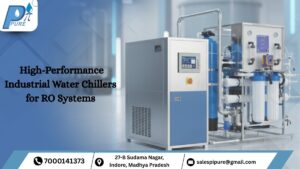
- Customized applications of industrial water chillers.
- Commercial water softener systems and demineralised water plants for water conditioning before RO treatment.
- Hybrid systems of ultrafiltration membrane filters to increase purification.
Why Choose the PI Pure RO System?
- High-tech Automation- RO control panel provides smooth running, real-time performance, and energy efficiency.
- Precision Chemical Dosing – Electronic dosing pumps are used to add RO antiscalant chemicals and membrane washing chemicals with precision to the sensitive membranes in the RO system.
- Integration & Compatibility – Compatible with Pp Filter Cartridges, wound filters, coconut shell activated carbon, and pre-treatment units.
- Quality Support – PI Pure RO System is a major manufacturer of industrial RO plants, providing long-term service, efficiency, and minimized operational costs.
Conclusion
The industrial reverse osmosis plants and commercial reverse osmosis systems rely on the mechanical and chemical balance to be efficient. Safe, automated, and optimized operations are ensured by the RO control panel, and the electronic dosing pump ensures membrane protection and the minimization of expenses on chemicals. They work together in protecting important components such as the RO system membrane and enable industries to obtain stable and quality water. To businesses that want long-term reliability, it is necessary to invest in such sophisticated technologies to ensure maximum performance of current RO systems.