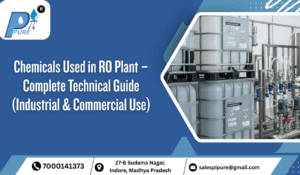
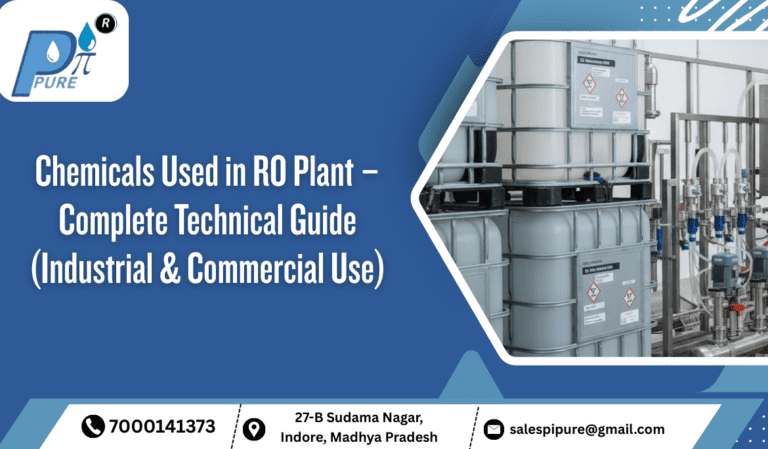
RO chemicals ensure that membranes are guarded and maintain the smooth operation of the system.
- The antiscalants inhibit scale; SMBS eliminates chlorine, and biocides eliminate bacteria.
- Membrane performance is restored with the use of CIP chemicals (acid and alkali).
- Industrial RO systems need stronger, precisely dosed chemicals.
- Scaling and fouling result in the use of the wrong dosage, as well as extensive damage to the membrane at a cost.
The Reverse Osmosis (RO) Plants are not only dependent on the use of membranes and pressure systems for their functioning, but also require the use of fine chemical treatment. Chemicals are very important in industrial and commercial RO systems to ensure that the membranes are safeguarded, enhance water quality, and that the performance is consistent. RO plants do not provide scaling, fouling, biological growth, and untimely loss of membranes without the correct dosage of chemicals.
To be sure that plants operate, it is necessary to understand what chemicals are applied and why.
Why are chemicals used in a Reverse Osmosis Plant?
The raw water is dissolved with salts, hardness, organic matter, bacteria, and suspended solids. Through RO filtration, these contaminants accumulate on the faces of membranes. RO chemicals help:
- Prevent scale formation
- Remove fouling deposits
- Control microbial growth
- Maintain correct pH levels
- Protect membranes from oxidation
- Improve filtration efficiency
Concisely, chemicals prolong the membrane life and stabilize the output of RO systems.
Main Chemicals Used in RO Plant
1. RO Antiscalant Chemical
Antiscalants inhibit the scaling of membranes by calcium, magnesium, and silica. They prevent the growth and dispersion of mineral deposits, which makes the flow of the permeate continuous.
2. RO Membrane Cleaning Chemicals
They are acidic and alkaline cleaners in use in CIP (Cleaning-In-Place). The removal of inorganic and alkaline cleaners can remove organic fouling, oils, and biofilm, respectively.
3. Sodium Metabisulfite (SMBS)
SMBS removes the residual chlorine and also safeguards RO membranes against corrosion due to oxidation. What makes it popular is that it is applied in pre-treatment processes to dechlorinate.
4. Coagulants & Flocculants
In pretreatment, to enhance the effectiveness of filtration and minimize membrane fouling in the case of fine suspended solids.
5. pH Adjustment Chemicals
Feed water pH is controlled by the use of acids (e.g., hydrochloric acid) or alkalis (e.g., sodium hydroxide) to get the best antiscalant effect and membrane stability.
6. Biocides in RO Plant
Non-oxidizing biocides prevent microbial growth in pipelines and in membrane housings, which stop biofouling.
7. Antifoaming Agents
These discourage the formation of foams during pretreatment or CIP processes, covering accelerated pump functioning and chemical circulation.
Chemicals Used in RO Membrane Cleaning (CIP Process Explained)
CIP is a process that entails the distribution of special cleaning solutions to the RO membranes in a bid to regain permeability. Typically:
- The cleaners with low pH are used to strip the scale and metal covering.
- Cleaners with high PH remove biological material and organic light.
- Heavy metals are bound with Chelating agents.
- Surfactants enhance the extraction of contaminants.
- The CIP at regular intervals does not decrease recovery rates, and irreversible damage to the membrane is avoided.
Regular CIP maintains recovery rates and prevents irreversible membrane damage.
How to Select the Right RO Chemicals?
Chemical selection is dependent on:
- Feed water analysis
- TDS and hardness levels
- Organic contamination
- Operating temperature
- Membrane type
Industrial vs Commercial RO Chemicals – Key Differences
Industrial RO systems require more powerful dosing systems and chemical formulae due to the higher levels of flow rate, TDS, and process wastewater.
The milder chemicals applied in commercial RO plants (hotels, hospitals, offices) have simpler dosing configurations whose primary objectives are scale prevention and disinfection.
Common Problems Due to Wrong Chemical Usage
Incorrect chemical dosing or incompatible products can cause:
- Membrane degradation
- Reduced permeate flow
- Increased operating pressure
- Biofouling
- Chemical corrosion
- Higher operating costs
One of the major reasons for RO system failure is poor management of the chemicals
FAQs
Antiscalant is necessary because scaling is the most prevalent membrane problem.
It inhibits scales on the RO membrane.
Usually, occurring with a rise in pressure drop of 1520 percent or a reduction in permeate flow by large amounts.