FRP Pressure Vessel & Reverse Osmosis Chemicals – What You Need to Know

Home / Blog / FRP Pressure Vessel & Reverse Osmosis Chemicals – What You Need to Know
FRP Pressure Vessel & Reverse Osmosis Chemicals - What You Need to Know

The efficiency and life of the system, in both industrial and commercial water treatment, are highly reliant on the supporting components. Frp Pressure Vessel and reverse osmosis chemicals are two of the most important components. They do this to protect the heart of the system, the reverse osmosis membranes, in order to maintain the economy, save costs, and guarantee quality water to the industry, including pharmaceuticals, food and beverages, textiles, and power generation.

What is an FRP Pressure Vessel?

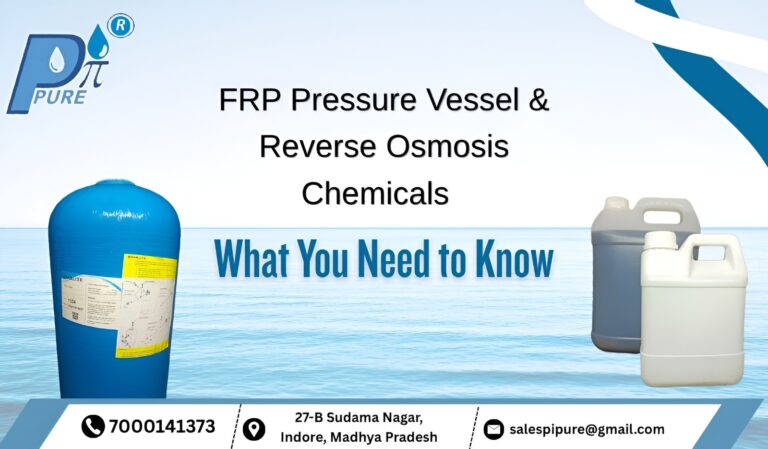
The housing unit, which holds the membranes in an industrial reverse osmosis plant or in a commercial reverse osmosis system, is an FRP (Fiberglass Reinforced Plastic) pressure vessel. FRP vessels are known to be strong, durable, and resistant to corrosion and are made to withstand the high pressures involved in the RO process.

The main benefits of FRP Pressure Vessels are as follows:

Lightweight and Durable – It is easier to install and maintain than metal vessels.

Corrosion Resistant – Better suited to the constant application in industries with different water quality.

Cost-Effective- Long service life decreases the number of replacements.

Compatibility – Compatibility is employed in FRP RO plants, mineral water RO plants, and in purifiers of industrial RO water.

FRP vessels, which entrap the membranes of the RO system in a safe and secure manner, enable the smooth operation of the systems and resist the pressure of thousands of liters of water per day.

Use of Reverse Osmosis Chemicals

To ensure the best reverse osmosis membranes work effectively, an appropriate combination of reverse osmosis chemicals is required. These chemicals include:

RO Antiscalant- Scaling and deposits on membranes are prevented.

Membrane Washing Chemicals –These are used every now and then to clean and restore performance.

RO Membrane Cleaning Chemicals – Prevent biofouling, iron deposition, and organic matter on membranes.

Antiscalant Chemicals – Lengthen the life of the membrane by preventing salt deposition.

The right dosage with electronic dosing pumps and control through RO control panels will guarantee the effectiveness of these chemicals, decrease downtime, and the cost of operations.

How FRP Pressure Vessels and Chemicals Work Together?

FRP vessel offer a robust and protective environment for membranes, whereas reverse osmosis chemicals maintain the membranes clean and efficient. This combination ensures:

  • Constant operation of the industrial reverse osmosis system.
  • Long life of the RO system membrane.
  • Less frequent replacement and use of chemicals.
  • Regular water quality to industries and manufacturing companies of the RO plants.
Industrial Applications

FRP vessels and RO chemicals cannot be used without in:

Pharmaceutical production- High purity of water.

Food and Beverage Sector – Commodity preservation.

Textiles and dyeing departments- Prevention of scaling on clothes and equipment.

Power plants/boilers- Soft, treated water for preventing corrosion.

Commercial RO applications – Hotels, hospitals, and institutions that need high-quality water.

Why Choose the PI Pure RO System?

Quality Maker of RO Plant in Industry – Experience in large-scale installation in industries.

State-of-the-art Technology- FRP pressure vessels, RO antiscalants, and control panels are used to ease operations.

Comprehensive Pre -Treatment – It utilizes PP filters, coconut shell-activated carbon, and multi-port valves for maximum efficiency.

Long-Term Reliability- Installation, maintenance, up to the supply of cleaning chemicals to the RO membrane, and after-sales.

Conclusion

FRP pressure vessel and reverse osmosis chemicals are both important to the stability and success of any industrial reverse osmosis plant or Commercial Ro Plant. Whereas the FRP vessel provides the vessel strength and protection, the chemicals ensure that membranes are not scale, fouled, and lose their performance. In the hands of professional reverse osmosis plant manufacturers in Indore and elsewhere in India, industries are assured effective, sustainable, and economical solutions to water treatment. 
In any reverse osmosis system, pre-filtration is as important as the main RO system membrane. The wound filter cartridge is one of the most popular pre-filters that are used in commercial and industrial reverse osmosis plants. We supply high-quality and long-lasting wound filters, which safeguard the membranes, enhance water quality, and improve the system’s efficiency in the long run, at PI Pure RO System, a reputable Ro Plant Manufacturer in Indore.

What is a Wound Filter? how Does It Work?

This is a wound filter that is a cartridge constructed by winding a taut polypropylene or cotton yarn around a central core. The direction in which the winding is conducted forms a pattern that creates a gradient structure, which encases particles of varying sizes across the filter. The special design permits wound filters to:

  • Get big particles on the outer layers.
  • Fine impurities are pushed further in.
  • Reduce the loads on reverse osmosis membranes to increase their lifespan.

Such filters are best suited to eliminating sediment, rust, sand, silt, and other suspended solids before water enters the RO process.

Wound Filter Cartridge Types and Uses

The PI Pure RO System proposes various wound filters by application –

Polypropylene Wound Filter Cartridges – These are the most useful in general applications in commercial reverse osmosis systems and mineral water RO plants.

Cotton Wound Filters – They are applied in a few industrial processes where they need to be compatible with chemicals.

Glass Fibre Wound Filters – Ideal in cases where it is high temperature and resistance to chemicals.

Such uses are industrial RO water purifiers, demineralised water plants, FRP RO plants, and ultrafiltration membrane filter systems.

Characteristics and Specifications of Wound Filters

What makes our wound filter cartridges unique – 

Great dirty holding capacity – Dirt holding capacity is very high, as opposed to good filters.

Custom micron ratings – 1-100 microns available to customise filtration to different levels.

Durability – Can be used effectively in FRP pressure vessels at high pressure.

Compatibility – Can be used with residential RO systems as well as large-scale industrial reverse osmosis systems.

How Wound Filters Improve Water Filtration Efficiency

Wound filters in your system guarantee –

Longer membrane life – Safeguards the finest reverse osmosis membranes against clogging and regular washing with RO membrane cleaning chemicals or membrane washing chemicals.

Increased system performance – Less downtime in commercial RO plants and industrial reverse osmosis plants.

Cost savings – Reduces the frequency of use of reverse osmosis chemicals and reduces the cost of operation.

Better water quality – Added value of taste and clarity, particularly when used with coconut shell activated carbon and RO antiscalant treatment.

Lifespan and Maintenance of Wound Filter Cartridges

In order to make performance consistent – 

Periodic cleaning – Periodically check the filter to make sure it is not clogged or discoloured, at least once every 2-3 months.

Replacement Cycle – Change wound cartridges at least every 3-6 months, based on the quality of raw water.

System Protection – Operate with other units such as multiport valves, electronic dosing pumps, and RO control panels to operate efficiently.

Professional Servicing – For very large industrial RO systems, adhere to maintenance schedules recommended by professionals.

Conclusion

A Wound Filter Cartridge is an easy but effective method that is essential in securing RO systems and in delivering quality water. In the PI Pure RO System, we provide the latest wound filters that are durable, efficient, and offer prolonged functionality in both commercial and industrial reverse osmosis plants. Wound filters can significantly extend the service life of your RO system and reduce maintenance expenses when properly maintained and replaced on schedule.

Translate »