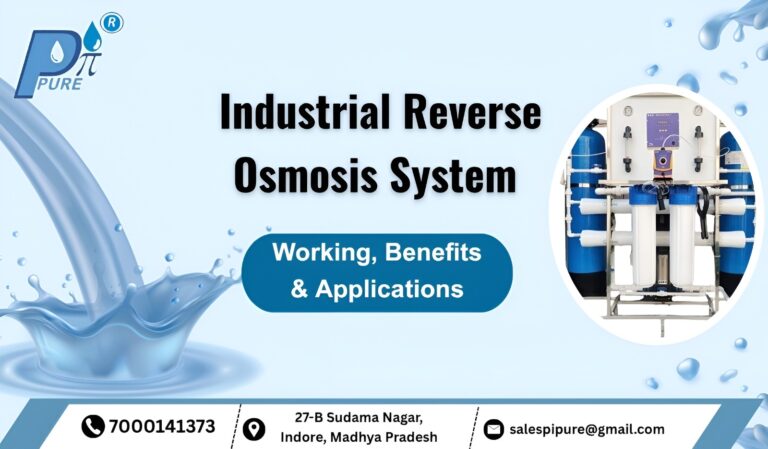
One of the most trusted technologies for producing high-quality, purified water in large quantities is an industrial reverse osmosis system. Applied in industries such as pharmaceuticals, food and beverage, textiles, and power generation, these systems are meant to treat the raw water of dissolved salts, organic matter, and impurities. They are equipped with various components, including reverse osmosis membranes, PP filter cartridges, and coconut shell-activated carbon, which ensure long-lasting functionality and stable productivity.
Working of an Industrial Reverse Osmosis System
An Industrial Reverse Osmosis Plant is operated in several steps of purification:
- Pre-Treatment – Raw water is filtered by PP filters, wound filters, or wound cartridge filters, which remove suspended solids, dirt, and rust. This safeguards the fragile membranes of the RO system. Other pre-treatment involves the use of coconut shell activated carbon to remove chlorine and antiscalant chemicals, thereby achieving preventive scaling.
- High-pressure pumping- The pumping of water is done under pressure through the pumps and pumped towards the reverse osmosis membranes.
- Membrane Separation –The most effective reverse osmosis membranes are semi-permeable, which means that they separate pure water and salts and other impurities.
- Post-Treatment – Depending on the application requirements, post-treatment could be in the form of commercial water softener systems, demineralised water plants, or ultrafiltration membrane filters to achieve ultra-clean water quality.
- Automation & Monitoring – A RO control panel is used to regulate the process, incorporating electronic dosing pumps and multi-port valves to provide efficiency and safety.
Advantages of Industrial Reverse Osmosis System
There are several advantages to investing in an industrial RO plant manufacturer:
- High Purity Output – The process produces water with up to 99 percent salt removal, contaminants, and chemical removal.
- Extended Membrane Life – The lifespan of the system increases when RO membrane cleaning chemicals and membrane washing chemicals are used appropriately.
- Cost-Effective Operation -Less frequent maintenance is required, as is the case with the traditional methods.
- Versatility- It fits mineral water RO plants, commercial reverse osmosis plants, and industrial water purifiers.
- Energy Efficiency – The latest systems, featuring industrial water chillers and intelligent control systems, optimise energy use.
The Uses of Industrial Reverse Osmosis Systems
- Food Beverage Industry – Provides safe water to manufacture, clean, and use ingredients.
- Pharmaceutical Manufacturing – Supply purified water to the extent needed by medicines and formulations.
- Textile & Dyeing Units – Eliminates the hardness and impurities so as to avoid damaging fabrics.
- Power Plants and Boilers – Use the demineralised water to avoid corrosion and scaling.
- Commercial RO Applications – Hotels, hospitals, and institutions can depend on commercial RO plant manufacturers to provide reliable water quality.
Supporting Components for Maximum Efficiency
The supporting equipment determines the performance of an industrial reverse osmosis system:
- FRP pressure vessels and FRP RO plants are durable and resistant to corrosion.
- Scales and bacteria prevention. Electronic dosing pumps control the dosing of chemicals.
- The RO antiscalants and reverse osmosis chemicals protect the system’s life.
- Distribution accessories, such as multi-port valves and monitoring panels, are used to simplify operations.
A reliable RO plant manufacturer in Indore or any other industrial city can offer comprehensive solutions tailored to client requirements, ranging from commercial RO systems to industrial reverse osmosis plants.
Why Choose the PI Pure RO System?
- Constancy Reliable Quality – Raised using advanced reverse osmosis membranes and cartridges made of PP filters to achieve high purifying capability.
- Complete Solutions- Starting with the industrial RO water purifiers to commercial reverse osmosis plants to suit any industry.
- Durability & Efficiency – FRP pressure vessels, electronic dosing pumps, and antiscalant chemicals are used to provide long-life performance.
- Knowledge and Assistance- it is a market leader in the manufacture of industrial RO plants, and has provided good service, advice, and maintenance services throughout India.
Conclusion
An industrial reverse osmosis system is not merely a water treatment solution, but a need for industries where a high quality of water is required. Designed with the latest technology in reverse osmosis membranes, PP filters, and coconut shell activated carbon, these systems ensure the system is efficient, clean, and economical. Selecting the right industrial RO plant manufacturer and keeping the system in use with the proper chemicals and accessories, one may guarantee the continuity of the performance and the long-term savings of the business.